How to Score Revenue Ranges Without Breaking Your B2B Lead Scoring Model
Revenue-based scoring remains one of the most widely used approaches in B2B demand generation, yet many organizations still apply it incorrectly. Simply giving larger companies higher scores often creates bloated pipelines, misaligned sales priorities, and inaccurate qualification. Modern lead scoring requires a more nuanced approach that combines revenue fit with buying behavior, stakeholder engagement, and commercial reality.
Marketing teams face increasing pressure to deliver pipeline quality rather than marketing-qualified lead volume. Sales organizations want fewer leads but better opportunities. Meanwhile, buying committees continue to expand, budgets receive greater scrutiny, and sales cycles become more complex.
This creates an important question:
How should organizations assign points to revenue ranges without distorting lead quality?
The answer is rarely straightforward. Large companies do not always become the best customers. Smaller organizations are not automatically poor opportunities. Revenue remains valuable, but only when viewed alongside buyer intent, account engagement, and actual purchasing conditions.
Why Revenue Still Matters in Lead Scoring
Company revenue remains one of the most commonly used B2B sales lead scoring criteria because it often provides insight into:
- Budget availability
- Technology investment capacity
- Organizational complexity
- Procurement processes
- Number of stakeholders involved
- Potential contract value
For many B2B organizations, revenue acts as an early qualification signal. Larger organizations often have greater purchasing power and larger transformation budgets. However, revenue alone rarely predicts purchase intent.
A $2 billion company researching industry trends may represent less opportunity than a $100 million business actively evaluating vendors.
The purpose of revenue scoring is not identifying the largest organizations. It is identifying the organizations most likely to become valuable customers.
The Problem With Traditional Revenue Scoring Models
Many lead scoring models still use simplistic structures.
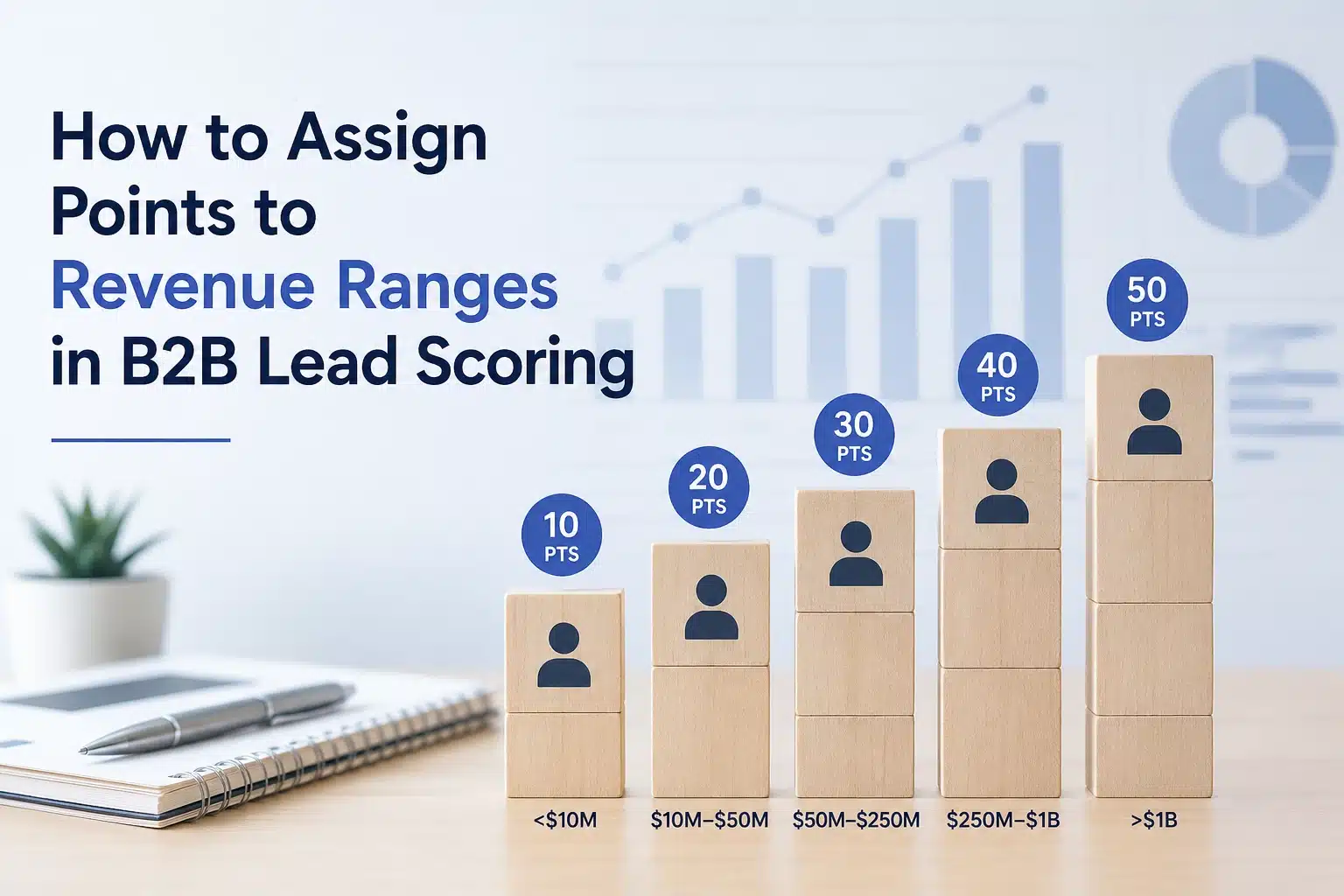
| Revenue Range | Score |
| Under $10M | 5 |
| $10M to $50M | 10 |
| $50M to $250M | 20 |
| $250M to $1B | 30 |
| Above $1B | 40 |
Although this appears logical, several problems emerge.
Enterprise bias
Large organizations receive high scores before demonstrating any interest.
Mid-market opportunities become overlooked
Many B2B companies generate their highest conversion rates from organizations that sit between small businesses and global enterprises.
Sales confidence declines
If highly scored leads repeatedly fail to convert, sales teams eventually ignore the scoring model.
Marketing optimizes for company size
Campaigns begin attracting large accounts that may never buy.
This is one reason many organizations revisit their scoring systems after noticing declining MQL-to-opportunity conversion rates.
How to Assign Points to Revenue Ranges
The most effective approach begins with historical customer analysis. Ask the following questions:
- Which revenue segments generate the highest win rates?
- Which accounts produce the strongest retention?
- Which companies expand after purchase?
- Which opportunities close fastest?
- Which accounts create the greatest lifetime value?
The answers often challenge assumptions. For example:
- Enterprise deals may generate larger contracts but require longer sales cycles.
- Mid-market accounts may close more quickly.
- Certain industries may outperform others regardless of company size.
A practical scoring model could look like this:
| Annual Revenue | Suggested Score |
| Under $25M | 5 |
| $25M to $100M | 20 |
| $100M to $500M | 30 |
| $500M to $2B | 25 |
| Above $2B | 15 |
This approach recognizes that larger companies are not always the ideal customers.
Revenue Should Reflect Customer Fit, Not Market Size
One of the most important B2B lead scoring best practices is aligning revenue scores with the ideal customer profile. Different organizations require different models.
Enterprise technology providers
Higher revenue often indicates better fit.
Mid-market software companies
Companies above a certain size may become difficult to serve efficiently.
Specialist consulting firms
Smaller organizations may represent faster decisions and stronger relationships. The key question becomes:
Which companies succeed with us? Not: Which companies are largest?
This distinction significantly improves scoring accuracy.
Combining Revenue and Buyer Persona Scoring
Revenue alone cannot identify buying readiness. The lead scoring B2B SaaS buyer persona model increasingly combines company data with stakeholder influence. Typical buyer scoring might include:
| Role | Score |
| C-suite | 25 |
| Vice President | 20 |
| Director | 15 |
| Manager | 10 |
| Individual Contributor | 5 |
Complex buying environments often involve:
- Finance stakeholders
- Operations leaders
- Technology teams
- Procurement professionals
- Departmental users
For example, a Chief Procurement Officer (CPOs) may receive a higher score because of decision authority, while multiple engaged managers may collectively signal strong buying intent.
Modern buying decisions rarely depend on one individual. That reality has changed lead scoring.
Why Account Scoring Is Replacing Traditional Lead Scoring
Many B2B organizations now prioritize account engagement over individual lead activity. A single contact rarely represents the entire opportunity. Instead, revenue teams increasingly examine:
- Number of engaged stakeholders
- Content consumption across the account
- Multiple website sessions
- Revenue fit
- Technology compatibility
Consider two examples:
Account A
- $1 billion organization
- One webinar attendee
- No additional engagement
Account B
- $150 million organization
- Five engaged stakeholders
- Multiple content downloads
- Demo request submitted
Most sales teams would prioritize Account B. This shift toward account-based scoring reflects how modern buying decisions occur.
Behavioral Signals Must Outweigh Revenue
One of the biggest mistakes in lead scoring is allowing firmographic data to dominate engagement. Buying intent is often more valuable than company size. Strong engagement signals include:
- Pricing page visits
- Product comparison activity
- Multiple website sessions
- Webinar participation
- Return visits
- Content downloads
- Demo requests
A balanced scoring model may allocate:
- 30% company fit
- 40% engagement
- 20% buyer role
- 10% intent signals
This approach prevents large organizations from automatically becoming high-priority opportunities.
Attribution Problems That Revenue Scoring Can Create
Large companies naturally generate more website traffic. More employees often means:
- More anonymous visits
- More content consumption
- More accidental engagement
This creates attribution challenges. Not every visitor represents a potential buyer. Examples include:
- Students conducting research
- Consultants gathering information
- Industry analysts
- Competitors
- Existing vendors
Revenue-based scoring can unintentionally amplify these false signals. Therefore, organizations increasingly require meaningful engagement before increasing lead scores. Examples of high-value actions include:
- Attending multiple events
- Visiting product pages repeatedly
- Downloading buyer guides
- Engaging multiple stakeholders
- Requesting conversations
This creates stronger qualification.
B2B Sales Lead Scoring Criteria That Improve Pipeline Quality
The strongest scoring models typically combine five major areas.
- Company Fit
- Revenue range
- Industry
- Organization size
- Market alignment
- Buyer Fit
- Seniority
- Functional responsibility
- Decision-making authority
- Behavioral Engagement
- Website activity
- Content interaction
- Event participation
- Buying Signals
- Intent data
- Research behavior
- Solution comparison activity
- Account Activity
- Multiple stakeholders
- Collective engagement
- Opportunity momentum
When these areas work together, sales teams trust the output. When one variable dominates, scoring accuracy declines.
When Revenue Should Carry Less Weight
Not every business benefits from aggressive revenue scoring. Revenue may deserve lower weighting when:
- Products serve multiple market segments.
- Mid-market companies convert faster.
- Product-led growth drives acquisition.
- Expansion revenue matters.
- Emerging segments create growth opportunities.
Many modern organizations assign only 10 to 20 percent of total scoring to revenue. The remaining score comes from:
- Engagement
- Buyer intent
- Account activity
- Role relevance
This creates greater flexibility.
AI and Predictive Scoring Are Changing Lead Qualification
Artificial intelligence increasingly influences modern lead scoring. Predictive systems evaluate:
- Historical conversions
- Closed-won opportunities
- Sales cycle progression
- Customer retention
- Engagement patterns
Interestingly, many predictive models discover that buying behavior often predicts conversion more accurately than company size. However, algorithms have limitations.
If historical sales teams focused exclusively on enterprise accounts, predictive systems may continue reinforcing that bias.
Technology can improve scoring, but commercial judgment remains essential. The best revenue teams combine data science with market understanding.
Questions Revenue Teams Should Ask Before Assigning Scores
Before building a scoring framework, organizations should consider:
- Which revenue segments close fastest?
- Which accounts renew most successfully?
- Which segments create expansion opportunities?
- Where does sales want more pipeline?
- Which opportunities consistently stall?
- What does the ideal customer profile actually look like?
These questions often reveal that revenue alone provides an incomplete picture.
A Practical Revenue Scoring Framework
An effective model often combines four dimensions.
Company Fit
- Revenue
- Industry
- Technology environment
- Business model
Buyer Fit
- Seniority
- Function
- Decision authority
Engagement
- Content consumption
- Event attendance
- Website activity
Buying Intent
- Research behavior
- Solution comparisons
- Active evaluation signals
This structure produces better alignment between marketing and sales.
Looking Beyond Company Size
Many organizations assume the largest accounts represent the safest growth opportunity. In reality, some of the strongest revenue performance often comes from companies that sit just below the enterprise tier.
These organizations frequently move faster, build internal consensus more efficiently, and experience fewer procurement barriers.
Revenue remains an important qualification factor. However, modern B2B lead scoring works best when company size becomes one signal among many rather than the dominant variable.
The organizations building stronger pipelines today are not simply assigning higher scores to larger businesses. They are identifying where commercial fit, stakeholder engagement, and buying intent intersect. That intersection is where genuine opportunities emerge.
Frequently Asked Questions
- How do you assign points to revenue ranges?
Analyze historical customer performance and assign higher scores to revenue segments that generate the best commercial outcomes rather than automatically prioritizing the largest organizations.
- How much weight should revenue have in lead scoring?
Most modern scoring models allocate between 10 percent and 30 percent of the total score to company revenue.
- What are the best B2B lead scoring practices?
Combining company fit, buyer role, engagement, intent signals, and account activity generally produces the strongest results.
- What is the biggest revenue scoring mistake?
Allowing company size to outweigh actual buying behavior often produces poor lead quality.
- Should revenue be used in account-based marketing?
Yes. Revenue helps identify attractive accounts, but it should be combined with engagement and stakeholder activity.